
 Jasmin Reda
SaaS vs Custom Software is one of the most important technology decisions a business owner can make when investing in digital transformation. Modern enterprises rely heavily on sophisticated software ecosystems to drive growth, streamline workflows, and secure market share. As macroeconomic conditions shift, organizations face growing pressure to automate operations and eliminate manual bottlenecks. This demand often creates an urgent dilemma at the heart of the SaaS vs Custom Software debate: do you quickly adopt a pre-built Software-as-a-Service platform, or do you invest the time to build and own a proprietary custom solution?
For many businesses evaluating SaaS vs Custom Software, the immediate convenience of rental cloud platforms seems like an obvious choice. However, renting software introduces operational boundaries, platform restrictions, and unpredictable subscription curves that surface over time. Conversely, building bespoke enterprise software delivers complete operational control and unique competitive advantages, though it demands a larger initial capital investment. While off-the-shelf options frequently appear far more affordable at launch, a proper SaaS vs Custom Software comparison requires evaluating the total cost of ownership across a three-to-five-year timeline. Doing so often reveals a much more nuanced economic reality. This article provides a comprehensive framework to help business owners look past initial price tags, analyze long-term operational impact, and make the right SaaS vs Custom Software decision for their strategic goals.
SaaS vs Custom Software: What Is SaaS? Subscription Software Explained
To effectively navigate the SaaS vs Custom Software decision-making process, it is essential to define the core mechanics of the cloud subscription model. Software-as-a-Service refers to a software distribution framework where a third-party vendor builds, hosts, and maintains an application, delivering access to end-users via web browsers and mobile apps.
Common real-world examples of this model include popular CRM platforms, cloud-based accounting systems, and centralized project management tools. These SaaS platforms operate on a multi-tenant infrastructure, meaning hundreds of different companies run their business operations on the same codebase while remaining isolated through permissions and access controls.
The primary characteristics of subscription software are immediate deployment, standardized feature updates, and predictable monthly or annual pricing tiers. Organizations often favor SaaS in the SaaS vs Custom Software comparison because it removes the need to purchase infrastructure, hire system administrators, or maintain source code internally.
However, this convenience introduces distinct operational compromises. Because the software is built for a broad market, its features are largely standardized. If an application lacks a workflow your team depends on, you cannot simply modify the platform’s architecture to fit your business. This limitation becomes a recurring theme in many SaaS vs Custom Software evaluations. Furthermore, your operations become tied to the vendor’s roadmap, leaving you exposed to feature changes, service interruptions, or subscription increases outside your control.
SaaS vs Custom Software: What Is Custom Software? Full Build vs Customization
On the other side of the SaaS vs Custom Software spectrum lies custom software development. This approach involves creating a digital platform engineered specifically around the workflows, compliance requirements, and operational objectives of a single organization.
B2B software engineering generally follows one of two implementation paths:
Full Custom Development: Building a proprietary web or mobile ecosystem from the ground up to support highly specialized business processes.
Platform Customization: Using an existing framework as a foundation while developing custom modules, data structures, and interfaces tailored to business needs.
The greatest advantage in the SaaS vs Custom Software discussion is ownership. Because your organization owns the intellectual property, you gain complete control over functionality, integrations, scalability, and future development decisions. This flexibility enables businesses to transform unique workflows into sustainable competitive advantages.
The trade-off for this freedom centers on time and capital. Building a custom platform requires a larger upfront investment and longer implementation timeline than deploying an off-the-shelf solution. Ultimately, the SaaS vs Custom Software choice often comes down to balancing immediate deployment speed against long-term operational autonomy.
Total Cost of Ownership: SaaS Hidden Costs Revealed
One of the most important considerations in the SaaS vs Custom Software debate is total cost of ownership. Many business leaders compare options based only on initial implementation costs, overlooking expenses that accumulate over years of usage.
The Per-User Escalation Trap
Most SaaS vendors rely on seat-based pricing. While a subscription fee may appear affordable at first, organizations evaluating SaaS vs Custom Software should consider how rapidly costs increase as teams grow. A company that scales from 20 employees to 250 employees can see software expenses multiply dramatically, eventually exceeding the cost of building a dedicated platform.
Locked Premium Features and Tier Walls
A common frustration in many SaaS vs Custom Software comparisons is discovering that critical functionality is locked behind premium plans. Advanced reporting, workflow automation, security controls, and integrations often require significant upgrades that increase recurring expenses.
Ongoing Integration and Storage Fees
As businesses mature, software ecosystems become more interconnected. Additional storage, API access, third-party connectors, and middleware subscriptions can create hidden costs that are frequently overlooked during an initial SaaS vs Custom Software evaluation.
High Vendor Dependency and Migration Barriers
Vendor lock-in represents one of the most significant long-term risks in the SaaS vs Custom Software conversation. The longer a business relies on a proprietary platform, the more difficult and expensive it becomes to migrate data, processes, and integrations elsewhere.
When SaaS Wins (And When It Becomes a Trap)
Not every SaaS vs Custom Software decision should end with custom development. Subscription platforms remain highly effective under specific operational conditions, particularly for businesses prioritizing speed, flexibility, and lower upfront costs.
Ideal Scenarios for Cloud Subscriptions
Early-Stage Startups: For founders evaluating SaaS vs Custom Software, SaaS often provides the fastest path to market validation.
Non-Core Standard Workflows: Functions such as payroll, accounting, and team collaboration rarely require heavy customization.
Highly Predictable Environments: Organizations with stable growth can forecast subscription costs with reasonable accuracy.
When Subscriptions Become an Operational Trap
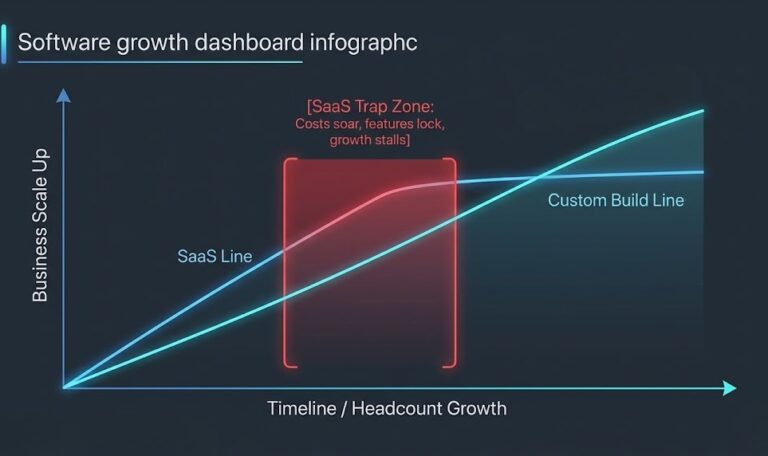
As companies grow, the SaaS vs Custom Software balance often begins to shift. Standardized workflows become increasingly restrictive, and teams may find themselves adapting their operations to fit the software rather than using software to support the business.
When multiple tools are required to compensate for missing functionality, costs increase, data becomes fragmented, and efficiency declines. At this stage, many organizations revisit the SaaS vs Custom Software question and discover that a custom solution may offer a stronger long-term return on investment.
When Custom Software Is the Right Investment
Investing in proprietary custom software development becomes the optimal financial and strategic move when your core operational processes cannot be accurately mapped to standard, off-the-shelf software logic.
Driving True Competitive Differentiation
If your company wins market share by delivering faster services, unique logistics, or a highly specialized customer journey, a pre-built platform will flatten those advantages. A proprietary platform allows you to design specialized digital features that competitors cannot easily copy.
Achieving Advanced Business Automation
Enterprise organizations often lose hundreds of hours to manual data entry across disconnected systems. Custom engineering allows you to build deeply integrated, automated systems that sync your warehouse data, sales pipelines, and customer portals instantly without relying on fragile middleware connectors.
Strategic Asset Creation and IP Ownership
Building proprietary software transforms an ongoing operational expense into a highly valuable corporate asset. Owning your intellectual property increases your company’s valuation, protects you from market vendor volatility, and gives you the long-term freedom to license out your custom technology as a separate revenue stream.
Scalability Comparison: Which Grows With Your Business?
Your technology infrastructure must adapt smoothly as your business scales, managing sudden surges in transactions, users, and global data without dropping performance.
Subscription Scaling Realities
With a subscription model, adding new users or opening regional offices is as simple as clicking a button inside an admin dashboard. However, your data structures remain strictly bound to the host vendor’s shared database rules. If your business requires specialized data structures, localized hosting environments, or heavy background processing, you will quickly hit the platform’s execution caps.
Custom Architecture Scalability
Bespoke systems are engineered from day one to match your company’s long-term growth strategy. Your architecture can be deployed on dedicated, auto-scaling private cloud servers, allowing your database performance to scale fluidly alongside your transaction volume. You gain total control over your indexing strategies, caching layers, and database optimization, ensuring your platform stays lightning-fast even as user workloads double.
Integration Flexibility: SaaS Lock-In vs Custom Freedom
A modern business cannot operate efficiently within isolated data silos. Your core technology must connect smoothly with external supply chains, public databases, and internal enterprise applications.
Navigating Subscription API Blocks
Most pre-built cloud tools offer basic API connections for other popular web services. However, these connectors are usually heavily rate-limited, restricting how many data transfers your system can run per hour. If your business relies on transferring large data packages or syncing live warehouse inventories, these vendor restrictions can create major operational delays.
The Freedom of Custom Systems
Building your own application gives you total software integration freedom. Your engineers can design native hooks to interface directly with specialized ERP systems, private banking APIs, legacy industrial hardware, or any external vendor network without paying extra monthly access fees. This architectural freedom eliminates data silos and creates a single, trusted source of truth across your entire organization.
Decision Matrix: SaaS or Custom for Your Business Stage
There is no single winner in the SaaS vs Custom Software debate. The ideal choice depends on your organizational maturity, process complexity, and long-term business goals.
Stage 1: The Bootstrapping Startup
- Operational Goal: Achieve rapid market launch with minimal capital expenditure.
- Recommended Path: Standard SaaS platforms. Use pre-built tools to prove your market concept before committing capital to heavy software engineering.
Stage 2: The High-Growth Mid-Market Company
- Operational Goal: Break down internal data silos and scale up your workforce.
- Recommended Path: Hybrid Approach. Keep standard SaaS options for basic back-office tasks, but start building custom software for your core, revenue-generating operations.
Stage 3: The Market-Leading Enterprise
- Operational Goal: Secure intellectual property, optimize complex automation, and drive market differentiation.
- Recommended Path: Dedicated Custom Software Ecosystem. Migrate your primary operations to proprietary code to maximize efficiency and build a strong competitive advantage.
How QTS Helps Businesses Make the Right Software Decision
At Queen Tech Solutions (QTS), we don’t believe in selling rigid, pre-packaged development templates. We approach technology through an advisory lens, ensuring every line of code we write delivers direct, measurable business value.
Thorough Discovery and Workflow Analysis
We begin our partnerships by diving deep into your day-to-day business processes. Our engineering teams analyze your active workflows, map out your technical bottlenecks, and audit your current application ecosystem to pinpoint exactly where manual tasks are draining your team’s time.
Realistic ROI and Capital Modeling
We build detailed financial models comparing the long-term subscription costs of off-the-shelf tools against the development costs of building a private platform. If a standard, pre-built application can solve your problem affordably, we will advise you to buy it. We only recommend custom development when our data shows it will deliver a distinct, long-term return on your investment.
World-Class Software Engineering and Integration
As a trusted software development company, our engineers build secure, high-performance web and mobile solutions tailored to handle heavy enterprise workloads. We specialize in crafting scalable cloud architectures, designing clean user interfaces, and building robust API connections that tie your internal ERP, CRM, and operational tools into a single, cohesive digital ecosystem.
Conclusion
Choosing between SaaS vs Custom Software depends on your business goals, growth plans, operational complexity, and desired level of control. Off-the-shelf subscription models deliver excellent speed and low initial costs for new startups and highly standard business workflows. However, as your organization grows and processes become more specialized, the rigid boundaries, per-seat price hikes, and API limitations of rented applications often slow down your momentum. Investing in custom software development transforms an ongoing monthly expense into an invaluable, proprietary corporate asset that streamlines your automation and sharpens your competitive edge. By analyzing your total cost of ownership across a multi-year horizon, your leadership team can choose the ideal technical path to protect your margins, secure your data, and accelerate your long-term business growth.
Reach out and Contact us Now!
Frequently Asked Questions About SaaS vs Custom Software
- What is the fundamental difference between SaaS and custom software architectures?
SaaS is a software rental model where businesses pay ongoing subscription fees to access a standardized application hosted on a vendor’s shared servers. Custom software is a proprietary platform built from scratch to match a single company’s exact operational rules, giving that business complete ownership of the source code and data infrastructure. This architectural distinction is the primary consideration in any SaaS vs Custom Software evaluation.
- Is custom software more cost-effective than a SaaS platform in the long run?
Yes, for scaling organizations, custom development frequently becomes more affordable over a three-to-five-year timeline. While pre-built cloud systems require a lower upfront investment, their per-user subscription fees scale linearly with headcount. As your workforce grows, those ongoing licensing costs quickly surpass the one-time development cost of a proprietary system.
- When should a growing business migrate its operations from SaaS to custom software?
Your company should consider migrating when your current pre-built platform begins forcing you to alter your internal workflows, locks critical features behind expensive enterprise pricing walls, or lacks the flexible API connections needed to sync smoothly with your other core line-of-business applications.
- What are the primary business risks associated with SaaS vendor lock-in?
The most significant risks include unexpected subscription price increases, sudden changes to key product features, platform downtime, and severe data migration barriers. Because you do not own the underlying technology infrastructure, you remain vulnerable to the vendor’s long-term corporate changes and product roadmap shifts.
- How long does a standard custom software development project take to launch?
A custom development timeline varies based on functional complexity, page count, and integration requirements. A minimum viable product (MVP) or targeted business tool can often go live within 8 to 12 weeks, while large-scale enterprise platforms requiring complex ERP connections can take 4 to 6 months of structured development sprints to complete safely.
- Which software option is better for supporting high-volume corporate scalability?
While off-the-shelf applications make it easy to add basic user seats, custom software provides superior structural scalability. It allows your technical team to optimize your databases around your specific transaction profiles and host your platform on dedicated private servers, ensuring lightning-fast performance even during massive shifts in transaction volume.