
 Heba Farid
Custom Software vs. Off-the-Shelf is the fundamental debate that every growing business eventually faces as its operations move beyond the capabilities of basic, ready-made tools. Most companies start their digital journey with off-the-shelf solutions because they are accessible, affordable, and quick to implement. However, there invariably comes a “choke point”, a moment where the limitations of a generic system begin to stifle innovation, slow down employee productivity, and create a disconnect between the brand’s vision and its actual operational execution. In the competitive landscape of 2026, the software you use is no longer just a utility; it is either a competitive advantage or a structural bottleneck. This guide explores the deep technical and financial nuances of the Custom Software vs. Off-the-Shelf comparison to help you determine if your current infrastructure is supporting your growth or quietly sabotaging it.
What Is Custom Software vs. Off-the-Shelf Software?
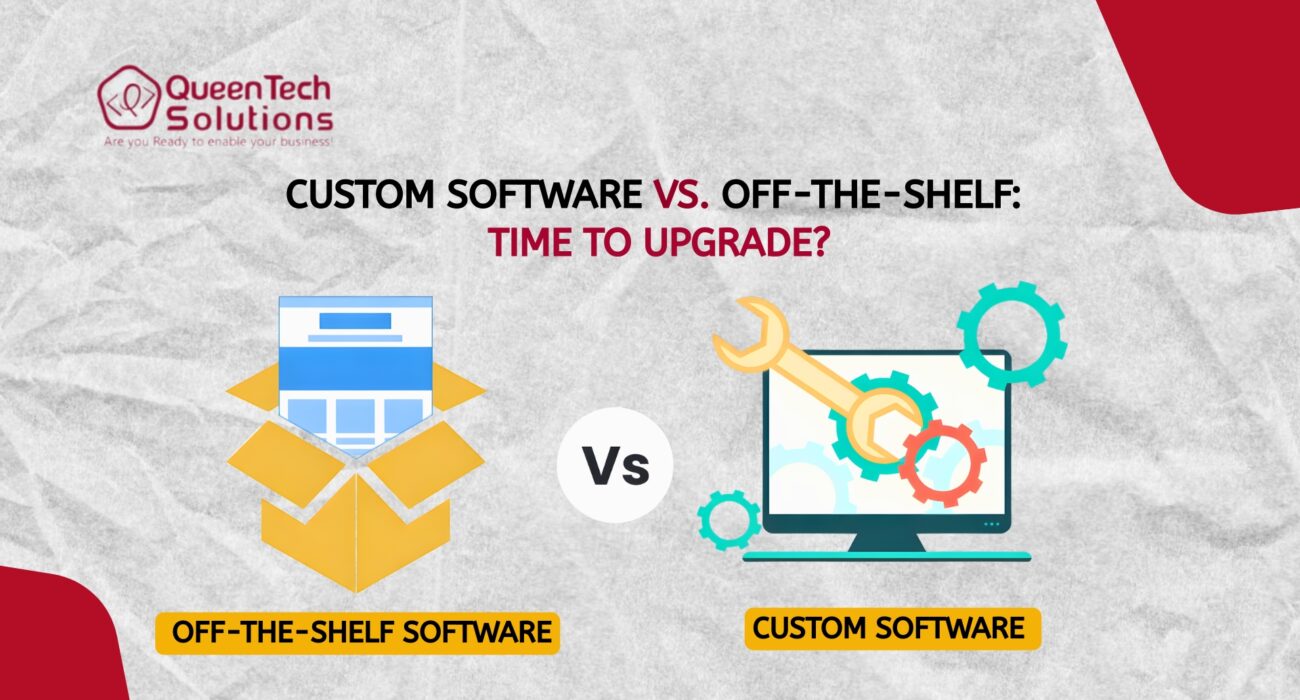
To make an informed decision, we must first define the core characteristics of each path. The choice between Custom Software vs. Off-the-Shelf is essentially a choice between “renting” a pre-built house or “building” a custom estate designed around your specific lifestyle.
What Is Custom Software?
Custom software is a bespoke digital solution designed, developed, and deployed for a specific set of users, functions, or organizations. Unlike mass-market products, custom builds are engineered to fit into your existing business workflows like a glove. At Queen Tech Solutions (QTS), we view custom software as a living asset. It is inherently scalable and flexible; as your business pivots or expands into new markets in Egypt or the USA, the software evolves with you. You own the code, the data, and the roadmap, meaning you are never at the mercy of a third-party vendor’s update schedule.
What Is Off-the-Shelf Software?
Off-the-shelf software (also known as commercial off-the-shelf or COTS) is a ready-to-use product designed for the “average” user. Think of Microsoft 365, Trello, or basic Shopify stores. These systems are (ready for use) and are significantly cheaper in the short term because the development cost is spread across millions of subscribers. While they offer a fast setup, they are built on the “lowest common denominator” principle, meaning they provide features that most businesses need, but rarely the specific features that your business needs to truly excel.
Quick Comparison Table: Custom Software vs. Off-the-Shelf
| Feature | Custom Software | Off-the-Shelf Software |
| Upfront Cost | High (Investment) | Low (Subscription) |
| Deployment Time | 3–9 Months | Instant / Days |
| Ownership | Full Ownership | Licensed / Rented |
| Scalability | Unlimited & Tailored | Limited by Vendor Tiers |
| Maintenance | Business Responsible | Vendor Responsible |
| Competitive Edge | High (Unique Features) | Low (Standard Features) |
Key Differences Between Custom Software vs. Off-the-Shelf
When evaluating Custom Software vs. Off-the-Shelf, the differences manifest in daily operations and long-term financial health. Let’s break down the critical comparison points:
Flexibility and Workflow Alignment
Off-the-shelf software forces your employees to change their habits to fit the software’s logic. If the software doesn’t have a specific field for your unique Egyptian customs documentation, your team has to “hack” the system using notes or external spreadsheets. Custom software does the opposite; it is built around your logic. If you need a specific automation that triggers a WhatsApp message to a client upon a warehouse scan, custom code makes it happen.
Cost: Short-term vs. Long-term
The initial price tag of Custom Software vs. Off-the-Shelf is often the most significant psychological barrier. Off-the-shelf software feels “free” or cheap at $50/month. However, as you add users and premium modules, those monthly fees stack up indefinitely. Custom software requires a large upfront capital expenditure, but once it is built, the ongoing costs are minimal. Over 5 years, the Total Cost of Ownership (TCO) for custom software often ends up being lower for established businesses.
Integration Capabilities
Modern businesses use a “stack” of tools (Email, CRM, Accounting, Logistics). Off-the-shelf tools often have “closed” ecosystems. They might integrate with popular apps, but connecting them to your local bank’s API or a niche Egyptian logistics provider can be impossible. Custom software is built with an “API-first” mindset, ensuring every part of your business talks to each other seamlessly.
Pros and Cons of Custom Software
Choosing to build a bespoke solution is a major strategic move. In the Custom Software vs. Off-the-Shelf debate, the advantages of going custom are centered on long-term sovereignty.
Advantages:
- Tailored Workflows: Every button and dashboard is there for a reason. There is no “bloatware” slowing down your team.
- Competitive Advantage: You can build features your competitors don’t have. If you develop a unique AI-driven pricing algorithm, it stays yours.
- Full Control: You decide when to update, when to add features, and how to secure your data.
Disadvantages:
- Higher Upfront Cost: It requires a significant budget allocation for design, development, and testing.
- Longer Development Time: You cannot use it tomorrow. Quality custom builds require a “Discovery” and “Development” phase that can span several months.
Pros and Cons of Off-the-Shelf Software
Ready-made solutions remain popular for a reason, but in the context of Custom Software vs. Off-the-Shelf, they serve a specific stage of business life.
Advantages:
- Quick Deployment: You can sign up and start working within minutes.
- Lower Initial Cost: High-quality software is accessible to even the smallest startups via a monthly fee.
- Jahiz (Ready) without Complexity: You don’t need to manage a development team or worry about server maintenance; the vendor handles it all.
Disadvantages:
- Limited Customization: You are stuck with the vendor’s UI and feature set. If they remove a feature you love, you have no recourse.
- Subscription Costs: You never stop paying. If you stop the subscription, you often lose access to your operational history.
- Workflow Mismatches: As your business matures, you’ll find yourself using 10 different off-the-shelf tools that don’t talk to each other, leading to “Data Silos.”
When Off-the-Shelf Software Becomes a Limitation
This is the most critical section for decision-makers. The Custom Software vs. Off-the-Shelf conflict usually reaches a breaking point when the business experiences rapid growth. Suddenly, the system that worked for 5 employees is failing 50 employees.
One of the biggest signs of limitation is Tool Fragmentation. When you have to use one software for HR, another for Sales, and a third for Inventory—none of which sync—your team spends 30% of their day doing manual data entry (Copy-pasting from one app to another). This is “Manual Workaround” territory. If your staff is spending more time managing the software than using it to serve customers, the off-the-shelf model has failed you.
Furthermore, poor reporting becomes a major pain point. If you want a report that shows “Profit per Customer vs. Shipping Speed” but your off-the-shelf tool doesn’t support that specific cross-section of data, you are flying blind. In 2026, data is the new oil; if you can’t extract it, you can’t compete.
Signs It’s Time to Upgrade to Custom Software
How do you know if you are ready for the leap? In the Custom Software vs. Off-the-Shelf journey, certain red flags indicate it’s time to upgrade:
- Complexity Overload: Your business processes have become so unique that “Standard” software simply can’t handle them anymore.
- Losing Efficiency: Tasks that should be automated (like invoice generation or follow-up emails) are still being done manually.
- Increased Operational Costs: You are hiring more “admin” staff just to manage the data flow between different ready-made apps.
- Customer Experience Issues: Your customers are complaining about delays or errors that are directly caused by your system’s inability to track orders accurately.
- Data Silos: You have five versions of the “Customer List” because every department uses a different tool.
If you can check off three or more of these items, the “cheap” off-the-shelf solution is actually costing you more in lost revenue than a custom build would cost in investment.
Cost Comparison: Custom Software vs. Off-the-Shelf
Let’s look at a real-world financial scenario to settle the Custom Software vs. Off-the-Shelf cost debate.
Imagine a growing logistics company in Cairo. They currently use a SaaS platform that costs $10 per user/month. They have 100 users. That’s $1,000/month or $12,000/year. However, the SaaS doesn’t track their specific fleet maintenance needs, so they pay for a second tool at $500/month. Total yearly cost: $18,000.
Now, consider the “Hidden Costs”:
- Manual Labor: Three employees spend 10 hours a week syncing data between these two tools. At $15/hour, that’s $23,400 a year in “wasted” salary.
- Errors: Manual entry causes a 2% error rate in billing, costing the company $10,000 a year in lost revenue.
Total annual cost of the “Cheap” solution: $51,400.
In contrast, building a Custom Software vs. Off-the-Shelf alternative might cost $80,000 upfront. By year two, the custom system has paid for itself by eliminating manual labor and errors. By year five, the company has saved over $150,000. This is why we say custom software is an asset, while off-the-shelf is an expense.
Real Business Scenarios (Use Cases)
The choice between Custom Software vs. Off-the-Shelf often depends on your current business stage:
Startup Stage
In the early days, speed is everything. Off-the-shelf is almost always the right choice here. You need to validate your business model, not build a perfect system. Using ready-made tools allows you to fail fast or scale quickly without a massive capital commitment.
Scaling Business (The Hybrid Stage)
As you reach the “Mid-Market” level, you likely have one or two core processes that are unique to you. This is where a hybrid approach makes sense. You might keep using an off-the-shelf tool for Email (like Outlook), but build a custom CRM or Inventory system that connects to it via API. This allows you to upgrade the “heart” of your business without rebuilding the “limbs.”
Enterprise Level
For large-scale enterprises, custom software becomes a necessity. At this volume, even a 1% increase in efficiency through a custom interface translates to hundreds of thousands of dollars in profit. Data ownership also becomes a legal and strategic requirement at this stage.
How to Decide: Custom Software vs. Off-the-Shelf
When facing the Custom Software vs. Off-the-Shelf decision, use this framework:
- Budget: Do you have the capital for an upfront investment, or do you need a low-entry monthly cost?
- Business Complexity: Are your processes standard (Accounting/HR) or unique (Custom Manufacturing/Niche Logistics)? Standard processes favor off-the-shelf; unique processes demand custom.
- Growth Plans: Do you plan to triple your size in 24 months? If so, off-the-shelf will likely break, and you’ll spend more switching later than building now.
- Integration Needs: How many other systems must this software talk to?
- Competitive Advantage: Does this software touch your customer? If yes, it should probably be custom to ensure a unique, high-quality brand experience.
Hybrid Approach: The Best of Both Worlds?
In 2026, the strict binary of Custom Software vs. Off-the-Shelf is blurring. The most successful businesses are moving toward a “Composable Architecture.” This means using the best SaaS tools for non-core functions (like Slack for chat or Zoom for video) while building custom “middleware” or core modules that tie everything together.
By using APIs (Application Programming Interfaces), you can have a custom system that “pulls” data from off-the-shelf tools. This gives you the speed of ready-made software with the precision of custom builds. It’s a modern, cost-effective way to upgrade your systems without a “total rip-and-replace” strategy.
Why Businesses Are Moving Toward Custom Software in 2026
The trend is shifting. More businesses are choosing Custom Software vs. Off-the-Shelf because of the rise of AI and Automation. Off-the-shelf tools are slow to implement AI that is specific to your data. A custom build allows you to integrate AI-driven workflows, like predictive inventory or automated customer sentiment analysis, that are trained on your unique business history.
Furthermore, data ownership is now a primary concern. In an era of increasing cyber threats and changing data laws in Egypt and internationally, owning your database is a security requirement. Businesses want to ensure their proprietary “Trade Secrets” aren’t sitting on a shared server with 500 other competitors.
Conclusion
When it comes to Custom Software vs. Off-the-Shelf, there is no one-size-fits-all answer. The right choice depends on your business stage, your specific pain points, and your long-term vision. Off-the-shelf software is a fantastic tool for getting started, but it shouldn’t become a cage that prevents your business from evolving.
If you find that your team is fighting against your software rather than being empowered by it, it is time to evaluate an upgrade. Strategic investment in custom technology isn’t just about code; it’s about removing the friction from your growth.
Is your current system holding you back? Would you like QTS to perform a System Health Audit to see if it’s time for you to make the switch? Talk to QTS and get a practical recommendation tailored to your business goals.

FAQ: Custom Software vs. Off-the-Shelf
- What is the difference between custom software vs. off-the-shelf?
Custom software is built from scratch for your specific needs, while off-the-shelf is a mass-produced product licensed to many users with standardized features.
- Is custom software worth the cost?
Yes, for businesses with unique workflows or high growth. The upfront cost is higher, but the long-term ROI is usually superior due to increased efficiency and zero subscription fees.
- When should I switch to custom software?
You should switch when your current tools require manual workarounds, fail to integrate with other apps, or can no longer scale with your transaction volume.
- Which is better for small businesses?
Generally, off-the-shelf is better for small businesses to keep costs low. However, if a small business has a highly unique service model, a small custom module can provide a significant competitive edge.